
Keeping human judgment at the centre of autonomous systems.
The Institute for Technology Stewardship develops practical governance for AI and emerging technologies operating in consequential environments — beginning with critical infrastructure.
Governance that meets infrastructure where it operates.
The systems ITS works with, including telecom networks, power and essential services, already run on continuous, automated infrastructure. Operational AI governance has to hold in those environments: on live networks, under real load, where a wrong action carries consequences.
See our focus areas →
When technology can act, governance must govern more than capability.
AI systems are moving from generating information and recommendations toward taking or initiating actions. As they do, governance has to answer a harder set of questions than "is the model accurate?"
- 01
What may the system actually do?
- 02
On what evidence, and when does that evidence stop being valid?
- 03
Who can restrict or stop it, and can a human intervene quickly enough to matter?
- 04
Who is accountable when an authorised action is wrong?
- 05
What is required before its authority can be restored?
One operating loop, six stages
ITS runs as a single loop, not a set of separate departments. Each stage feeds the next, and evidence from practice returns to research.
Investigate
Research the unresolved operational-governance problems that appear where autonomous systems meet consequential operations.
Research →Challenge
Expose the findings to practitioners across operations, assurance, risk, security, legal and research before they harden.
Contribute →Codify
Turn the strongest findings into frameworks, controls, decision tools and implementation artefacts.
Frameworks →Teach
Translate the methods into ITS Academy learning and practical exercises teams can use.
Academy →Implement
Apply and test the methods through readiness reviews, tabletops and fixed-scope organisational work.
Work with ITS →Evidence
Feed lessons from practice back into research and framework revision, where the loop begins again.
Evidence ↑ back to InvestigateWhat is active right now
Founding exchange forming
When should operational authority be withdrawn from an AI system?
Take part →Human Judgment Protocols for Autonomous Systems
How human authority holds when systems act faster than people can intervene.
Read the research →Free foundation programme
A self-paced introduction to operational AI governance for critical infrastructure.
Start learning →CI-AIGAF v1.0 · EU-TEL Beta
The flagship governance and assurance framework and its telecom and EU sector profile.
Open frameworks →Learn, contribute, or implement
ITS Academy
Build practical capability in operational AI governance, starting with a free foundation course for critical infrastructure.
Explore ITS Academy →Practitioner Exchange & Review
Bring operational, legal, assurance, security, research or policy expertise into focused governance questions.
Contribute to ITS →Work with ITS
Bring operational AI governance into an organisation through workshops, tabletop exercises and readiness reviews.
Work with ITS →Capability does not confer authority.
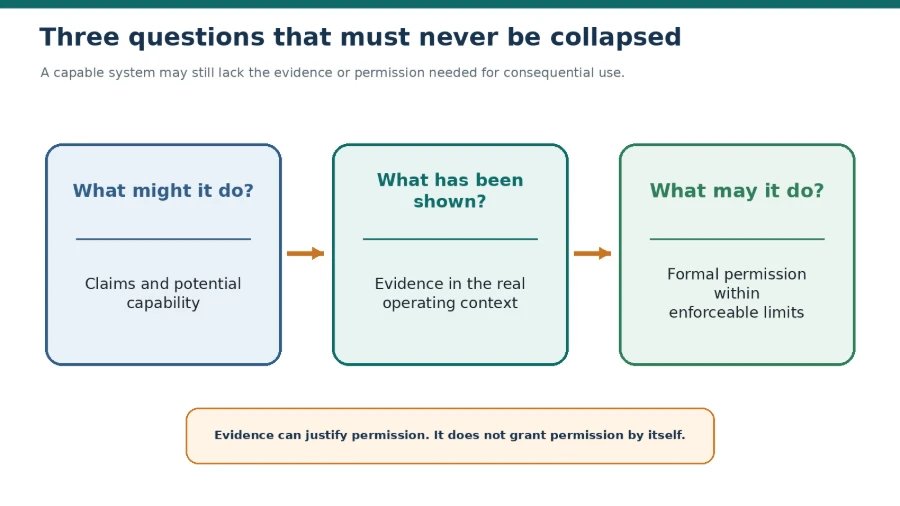
Most AI governance asks whether a system is accurate, safe or compliant. Critical infrastructure adds a harder question: what is this AI-enabled service actually permitted to do, on what evidence, within what conditions, and what happens when those conditions stop being true?
CI-AIGAF is ITS's response: an operational framework that treats an AI system's authority as a bounded decision backed by evidence, monitored in use, and withdrawn or restored deliberately. It is not a property that arrives automatically with capability.
Explore more ITS work
Now, next and on the horizon
One principle carried across domains: authority, evidence, intervention, accountability and resilience.
ITS in practice
Public work that shows how ITS is turning its mandate into research, frameworks, learning and applied practice.
CI-AIGAF
A public framework specification for authorising AI in critical infrastructure: what a system may do, on what evidence, and when that authority is withdrawn.
Read CI-AIGAF → PublicationsPublic research & issue papers
Independent, evidence-led papers on operational AI governance that sit behind the frameworks and methods.
Browse research →